AQI Policy & Guidelines
In light of occasional poor air quality in Minburi, RIS has implemented a school-wide AQI policy based on information from the Environmental Protection Agency (EPA) and the World Health Organization (WHO). This policy aligns with practices followed by other local international schools and aims to safeguard the health and well-being of our students, staff, and community.
Air pollution is a growing global concern, with both long-term and short-term health impacts. Children are particularly vulnerable due to their developing lungs, higher physical activity levels, and increased susceptibility to respiratory illnesses. RIS actively monitors air quality, focusing on Particulate Matter 2.5 (PM2.5), fine particles that can enter the lungs and bloodstream, to take appropriate actions when pollution levels rise.
AQI Levels, Actions, and Protocols
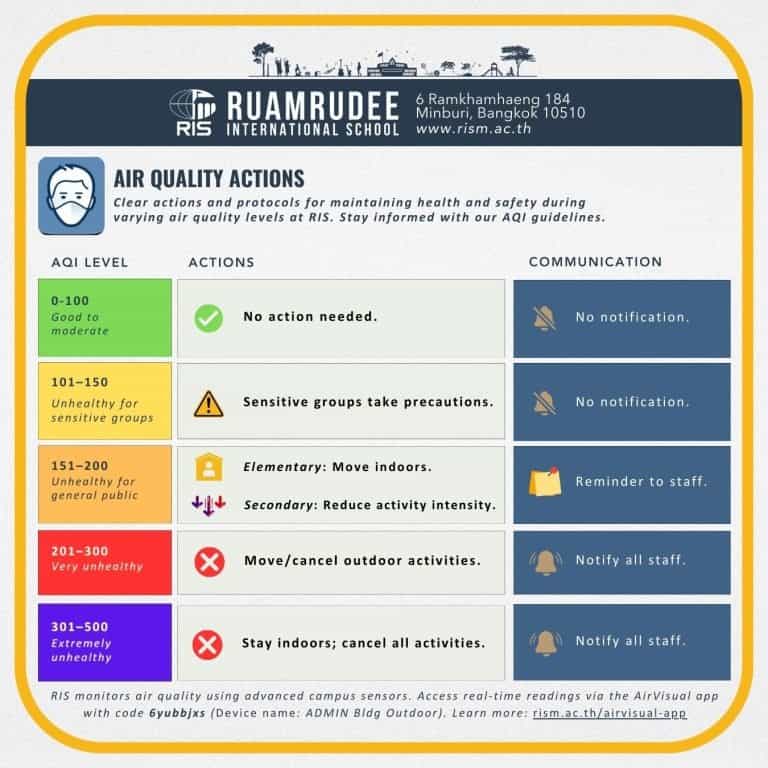
The following table summarizes the AQI levels, descriptions, corresponding actions, and communication protocols:
| AQI Level | Description | Actions and Meaning | Communication Protocol |
|---|---|---|---|
| 0–100 | Good to moderate | No action necessary. | No notification necessary. |
| 101–150 | Unhealthy for sensitive groups | Activities continue as planned; sensitive groups should limit prolonged exposure. | No notification necessary; sensitive groups advised to take precautions. |
| 151–200 | Unhealthy for general public | Elementary: All outdoor activities moved indoors. Secondary: Outdoor activities reduced to low intensity or shorter durations. | Faculty reminded to modify activities; Athletics Director advises PE staff. |
| 201–300 | Very unhealthy | All outdoor activities postponed, canceled, or moved indoors. | Notification sent to all staff and faculty to adjust activities as needed. |
| 301–500 | Extremely unhealthy | Everyone remains indoors except for essential movement; all outdoor and off-campus activities are canceled. | Notification sent to all staff and faculty with instructions to remain indoors. |
Monitoring Air Quality
RIS monitors air quality on campus using advanced devices that measure PM2.5 levels. Real-time AQI readings can be accessed through the “AirVisual” app or website using the code 6yubbjxs for the primary sensor located in the administration building (Device Name: ADMIN Bldg Outdoor).
For detailed instructions on how to set up the AirVisual app and link the RIS AQI monitor for the most accurate local readings, please visit: https://www.rism.ac.th/airvisual-app/.
Additional Guidelines for Sensitive Groups
Students and staff with respiratory issues or other health concerns are encouraged to take extra precautions during elevated AQI levels. Parents may request additional accommodations, such as allowing their children to stay indoors during recess or other outdoor activities, even at lower AQI levels.
RIS is committed to ensuring a safe and healthy environment for our community. By adhering to this AQI policy and staying informed, we can collectively minimize the impact of air pollution on our health and well-being. For any questions or further clarification, please contact the administration office.